
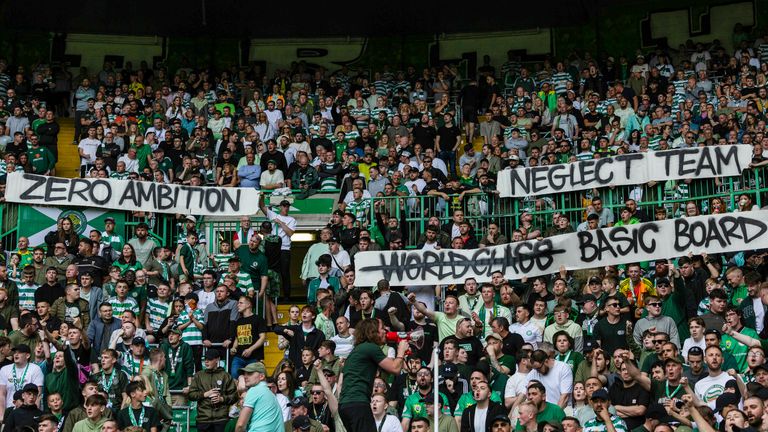
Those of you who watched Celtic’s latest failure in European qualifying might have heard the discontent coming from the stands during the first leg against the Kazakhstan champions of Kairat Almaty. Chants of “sack the board” were heard several times throughout the match, coming from elements of the Celtic support who are unhappy with the lack of investment in the team.
Yes, I can appreciate there will be many within Scottish football circles who will laugh at the very notion. Around the seventy minute mark of the second leg, Celtic brought on Adam Idah and Arne Engels, two players who cost Celtic a combined total of £20 million pounds last summer. Spending money that even city rivals Rangers look at and envy.
But every club has a budget in which they operate, it just so happens that Celtic’s budget is higher than that of any other team in Scotland. You have to look at what they do, indeed in what any club does, within their own context. When you do that, you see that Celtic, a team who just six months ago came within seconds of beating Bayern Munich in Germany in 90 minutes and taking their knockout round tie to extra time, have gone backwards in terms of squad quality.
For one thing, by the time that tie came around, Celtic had already cashed in on Kyogo Furuhashi, the talismanic Japanese striker who had scored more than a few key goals for Celtic in the three and a half seasons he spent at the club. Celtic didn’t replace him when they did that, and at time of writing they still haven’t. Indeed, Celtic were arguably light on strikers even before Kyogo’s departure, given Adam Idah was the only other recognised player for that position. But of course, Celtic managed to get by given that Daizen Maeda can also play up front and indeed it may even be his preferred position.
Nicolas Kuhn is another player who played a key role in Celtic’s Champions League campaign last season, never more so than his two goals in the league phase against RB Leipzig. Celtic sold him this summer to Como, and have yet to really replace him either. Indeed, the players that Celtic have brought in have cost in total around £3 million.
To put that in context, Jeremy Frimpong’s summer move to Liverpool has banked Celtic more money than they’ve spent this summer due to the sell on clause that Celtic had when he left them to go to Bayer Leverkusen. Never mind the money banked from the sale of Kyogo or Kuhn or anyone else that Celtic have cashed in on in recent years.
Celtic have a lot of money burning a hole in their bank account just now, and it’s very hard to see what the intent behind that could be. They’ve made a decent profit in just about every transfer window for years now. Add to that the money they rake in from season ticket sales (there’s a waiting list to get one), merchandise (three new kits every year as well as training ranges, limited editions tops and whatever else they can think up to sell), Scottish football prize money and tv deal money (could be better compared with other countries but still not insignificant) and of course participation in the Champions League due to automatic qualification for the group stage or league phase over the last three seasons.
Celtic are an extremely risk averse club when it comes to spending. This summer is nothing new, as they have frequently failed to invest in the side at this time of year because of the uncertainty of the income they’ll get from European competition. Even when they do have that certainty, Celtic have a tendency to drag out negotiations for players. The aforementioned Idah and Engels were signed a the very end of last season’s transfer window. And keep in mind that Idah had been on loan at Celtic the previous season, so it wasn’t like he was an unknown to the club.
But there is some merit to what Celtic do. When you have to qualify for the Champions League, but may only end up in the Europa League, there is quite a significant drop in income if you fail. This is as true now as it was more than two decades ago when Celtic failed to qualify for the the Champions League in 2002/03 and still didn’t make up the lost income by going all the way to the UEFA Cup final that season.
Celtic have failed a lot to qualify too. Including Kairat Almaty, Celtic have now failed to qualify for the Champions League in their last five attempts through qualifying. Forget the automatic qualification of the last three seasons, Celtic haven’t won their way through a qualifying campaign since the 2017/18 season. Indeed, of their last ten Champions League qualifying campaigns, Celtic have only won three.
It’s not like Celtic are playing against vastly superior opponents in these ties either. Kairat Almaty’s squad was assembled for less money than Celtic paid for Arne Engels. In 2021, Celtic fell to Midtyjlland of Denmark as Ange Postecoglou picked up the pieces of the shattered ten in a row dreams. Neil Lennon’s side lost out to Ferencvaros in a one leg home time in 2020. Cluj also beat Lennon’s side at Celtic Park the year before. AEK Athens stopped Brendan Rodgers making it three qualifications in a row in 2018. Ronny Deila’s Celtic fell to Malmo and Maribor – and even the latter was after a reprieve from UEFA when they overturned Legia Warsaw’s victory.
Celtic haven’t faced a side with a superior budget in Champions League qualifying since Tony Mowbray’s side came up against Arsenal in the non-Champions side of the draw back in 2009. Champions League qualifying is actually weighted in Celtic’s favour as long as they win the league – something they have clearly done almost every season since 2012. Yet somehow they still contrive to fail to do so far too often. So there’s definitely an argument here that what Celtic do invest in the playing side should still be enough to do better than three out of ten in terms of qualification.
If you go far enough back, you see instances where the likes of Martin O’Neill and Gordon Strachan also suffered from the same mentality. O’Neill had to try and build after the UEFA Cup final in Seville and all he got from that was the loan signing of Michael Gray on the last day of the transfer window. Unsurprisingly, the UEFA Cup finalists did manage to get through Champions League qualifying that season, and all they got was a lesser spotted loan winger for their trouble. O’Neill’s next season saw him have to replace the talismanic Henrik Larsson with another loan signing in Henri Camara and the free transfer of Juninho. Replacing someone like Larsson was always going to be difficult, but doing it with one hand tied behind your back is impossible.
Gordon Strachan then followed O’Neill and somehow managed to maintain the quality whilst also reducing the budget at the same time. The same nine points out of nine in home games in the Champions League as O’Neill managed in his first crack at it, without the bad luck of still only finishing third in the group. And Strachan did that two years running! But eventually Strachan’s time at Celtic stumbled to an end with a couple of 0-0 draws against the Edinburgh side after the purse strings had failed to get another striker in during the January transfer window. Whether Steven Fletcher would have made a difference that season or not will remain an unanswered question, but if Celtic had won those final two games even by a single goal they’d have won four in a row under Strachan.
O’Neill, Strachan, Mowbray, Lennon, Deila, Rodgers, Postecoglou. Seven men who have all experienced exactly the same frustrations and exactly the same problems when it comes to managing Celtic. Seven men who have delivered different levels of success in their time, and yet seven men who have all experienced frustration at not being able to do more.
Well, six. Tony Mowbray arguably had the frustration of having to build from a position of stagnation left behind by Strachan, who himself got off to a rocky start as he was doing likewise. Ange Postecoglou had the same thing when he followed Neil Lennon – a squad that practically needed ripped up and started again.
These things are two symptoms of the same problem though. Celtic not investing in the squad at the right time. Whether it’s allowing it to stagnate, possibly because the manager has indicated he’s leaving soon, or whether it’s allowing a full summer to elapse before panic buying whatever ever is left at the end of the transfer window, it all points to the one commonality across all their tenures.
The Celtic board.
The basic mentality has been the same across more than twenty years now. Keep within a budget, to the point of being so risk averse that it becomes an issue. Peter Lawwell joined Celtic during the 2003/04 season, and as much as he’s the usual fall buy it was actually Celtic chairman Brian Quinn who was first to pour cold water on the building from success that saw Celtic reach their first major European final since 1970. He was the one that pointed out that Celtic’s failure to beat FC Basel in Champions League qualifying was almost but not quite mitigated by the run the final. Celtic thus made a loss in 2002/03, due mainly to the wages that O’Neill’s stars were being paid. That had to change, and Celtic haven’t really been in the same position since.
They also haven’t won a non-qualification European knockout tie since beating Barcelona in 2003/04. The quarter final defeat to Villarreal that followed that is as close as Celtic have come to a European final since Seville. Across the city, Rangers fans have been to a European final, seen their club be liquidated and then start over in the fourth tier of Scottish football, and then been to another European final since Celtic fans went singing and dancing out of the Camp Nou that night.
You could argue the fact that Celtic don’t make losses means Celtic are a well run business, but are they really? Almost every business grows by taking an element of risk. No risk, no reward, as the saying goes. Celtic don’t take risks, and they use the fate of Rangers in 2012 as a scary story for anyone who choses to suggest they should. But that’s a bit of a fallacy given Rangers fate was sealed by overusing a tax scheme in a way that wasn’t how it was designed to be used in an effort to be able to spend more, not that they just spent beyond their means.
They also did that through a friendly Bank of Scotland and a huge overdraft facility there, but Lloyds TSB were reining that in during the final few years after their acquisition of BoS, the overspending was being managed. The boom and bust approach is one viable way of achieving success after all. Spend big to get the win and then cut your cloth for a while to balance it out. But that’s very difficult to pull off in an environment where first is everything and second is nothing, such as where Celtic and Rangers operate.
Let’s be clear about this though. No one is saying Celtic have to spend beyond their means. No one is suggesting the boom and bust approach be applied here. Not to the point of making a loss for a bit and letting in balance out in the years after, never mind doing something like a Gretna and spending so far beyond the club’s means that you eventually go bust. Remember, Celtic have plenty of means just sitting there in the bank that they’re not using, as well as consistently taking far too long to make changes to the squad that by the time any are made it’s actually too late. Celtic might well strengthen before the end of the transfer window this summer, but it’s too late, the Champions League playoff signing deadline was the real red line, not September 1st. These are the points that irk so many.
There are other ways that the Celtic board fail too. There’s so many non-football related ventures they just don’t do properly because it’s too hard. When you have 50,000+ season ticket holders and a waiting list of years to get that, where’s the forward planning? Capacity increase of the stadium just isn’t considered, despite having a main stand that isn’t fit for purpose today as it is – that’s why you always see a tent outside it on European nights. But a proper rebuild of that stand would cost a lot, and there’d be a reduction in capacity while it was happening, so that’s a big change. So never mind sorting that, why is there no ticket exchange scheme at Celtic? There’s plenty of times fans can’t go for whatever reason, why can’t they sell on their tickets through the club to someone who can but can’t get a ticket as the sold out signs keep going up? Too hard to implement, apparently, although you can do it at other clubs.
What about the footprint of the stadium? Have you ever tried to find a toilet when you’re outside of the stadium? The Emirates across the road is your best bet, and I don’t fancy even the early portion of 60,000 people all doing that. What is there to even do outside of the stadium besides go into the club shop? Nothing, but of course the lack of a fan zone is blamed on the council or the police not allowing it and anything else would be too hard to organise. What about when there’s no game on, what’s enticing people to come near the stadium then? The players are all up at Lennoxtown, so it’s not signings. The tour might be a good bet, but that’s one visit and then you’re done. We’ve heard planning applications for a museum and even a hotel over the years, but they always fall short. Rangers have a museum, which is weird as it’s Celtic fans who have a line of a song that says “if you know your history”, right?
Celtic even fail at good governance. The board at Celtic have been in place, with the odd exception, for more than twenty years now. Anyone who knows anything about corporate governance will be sick in their mouth at the thought of such a stale setup. But that’s just the norm at Celtic. They stand down on rotation and get voted back in by the handful of people who have the vast majority of the Celtic shares. Where’s the fresh ideas? From what we can tell from the outside, they don’t want fresh ideas. Dom McKay was brought in and quickly left soon afterwards. Whether or not he was the right fit we’ll never know for sure, but it’s been suggested he had ideas of things to change that got shot down.
Fergus McCann may have sold the club back to the fans in 1999, but in reality he sold control of the club to a handful of people that amount to Dermot Desmond and his friends – or at least those he can influence. The regular fans who have shares are holdings that are too small and ultimately vastly outnumbered to vote for any meaningful change, even if people like the The Celtic Trust did actually manage to locate all the missing shareholders (there’s quite a few out there for people who have moved, lost contact or died and had the shares passed on).
There’s simply no reason for the Celtic board to change anything. Dermot Desmond is happy to keep Celtic top in Scotland and that’s it. He has very little interest in anything else, unless he can get Celtic into the English Premier League – a pipe dream that has zero chance of ever happening. The EPL doesn’t want it. Of course, this does help fuel conspiracy theories though. Celtic need Rangers because they’re the package deal, and so every so often Celtic self-sabotage to make sure the gap doesn’t become insurmountable. Like 2005, like 2009, like 2020 (all times of managerial change and subsequent squad rebuilds you’ll note). Hey, it’s why Peter Lawwell was so involved in the five way agreement and the Sky renegotiations around Rangers and their journey from Division Three, right?
Celtic’s board should be ensuring that the shareholders are getting the best value. That’s literally their job, they have a legal obligation as the board of a Public Limited Company to do. that. But since they’re basically friends of the main shareholders, it’s really about doing whatever they want and who cares what anyone else thinks. The balance sheet is healthy, the bonuses are paid regardless of what happens on the park, so everything is good there. That they could do far better is subjective and there’s nothing in the rules about being rubbish at it anyway.
But this is also why singing songs about “sack the board” don’t make a difference. They’re too thick skinned to let those bother them. Same with banners, or even protests in the car park. They don’t care what the fans think, only what they do.
And whisper it, but those same chants and banners and protests didn’t make any difference to the old Celtic board in the 1990s either. What they did do, however, was drum up support for change from within the Celtic fans themselves. Support that culminated in boycotting games to the point that attendances dropped below 10,000 – although, not according to the old Celtic board who still claimed attendance above that mark. The Celts for Change people outside with the clickers knew better. Importantly, so did the bank. That’s the point that the bank sat up and noticed. Once the bank stepped in, the board had to do something, and that was ultimately to sell to Fergus McCann before they went under.
The uncomfortable truth for Celtic fans is that this is as true today as it was back then. The only way to send a message to the Celtic board is to stop giving them money. As much as I’ve said they’re bad at business, they only get away with being bad at it because football isn’t like other businesses. Football has fan loyalty… sorry, fan faithfulness. Any other business has customers who can go elsewhere if they’re not happy. So if you are one of those fans who truly want to change things at Celtic, the faithfulness has to dry up to impact those in charge.
But to do that, you also then have to accept your own pain in the process. You’re going to miss games, and that’s hard if you’ve been going year in year out through thick and thin. It’s especially hard when there’s domestic success on the park more often than not, because then you’re missing out on that too.
You’re not going to have the latest merchandise. You’ll even have to put up with being told things to play on your guilt about how your lack of investment in the club and lack of vocal support at the games is going to hurt the team – although you’re doing this because they don’t invest anyway, so actually you’re just hurting that bank balance and their bonuses, right?
You’re also going to have to accept that such a boycott is only going to work if enough people join in. You can’t just withhold your money, the only person who is going to notice that is you. And you’re not going to get everyone to join in. There’s a large section of the support who are happy just to dominate Scotland and Europe is an afterthought, nothing more than a nice to have as long as the league titles keep coming in and if there’s doubles and trebles to go with that then even better. Being one step ahead of Rangers is enough for them – accepting that the rest of Scottish football isn’t going to trouble you in the league of course.
It’s harder than that too. Those same fans are probably going to turn on you too for daring to threaten that position they enjoy. The fans of other clubs will call you entitled, too greedy for so many trophies still not being enough for you. Not to mention that there’s a queue of fans who might just take your seat if you don’t. You might only be impacting the waiting list, which doesn’t really make any money for the club anyway. If you don’t get enough people to follow you out the door, all that happens is you miss out and nothing changes at all. That’s the risk you take, and let’s face it, you can’t really quibble about the Celtic board being risk averse if you are the same way.
Then again, personal risk and corporate risk are two very different things. Personal risk is as it sounds, it’s personal. The fear of missing out, the fear of being shouted down, these are powerful emotions that come with that risk. That is almost certainly going to be enough to stop many people who want things to change from taking the action necessary to make that change happen. Ask those Celtic fans who took action to remove the old board in the 1990s, they’ll tell you how hard it was to go up against their own to try and make things change.
That’s a universal truth though, not just in football but everywhere in life. Change is hard. You have to sacrifice to make change, and many times people are not willing to sacrifice until they become desperate. For many at Celtic, it’s hard to be desperate when you’re the most successful team in the country. You’ve seen your team go to Seville for a European final, you’ve seen them beat Barcelona more than once, you’ve seen them win title after title, nine in a row at one point, and even a completely unprecedented quadruple treble. How can that be seen as desperate?
Then again, maybe three qualification wins out of ten is desperate. It just depends on your focus.
Regardless, the frustrations are clearly growing as once again the same mistakes have been repeated. The Celtic fans are restless, so maybe there is enough in there who think that domestic success isn’t enough ambition for a club as big as Celtic.
But you also have to remember that we’re in a climate where the cost of living is hard too. Prices keep rising, and that includes football. Season ticket prices at Celtic keep going up and they’re eyewatering to many. They also don’t include as many games, it used to be you got 21 games (19 league games plus two nominated by the club) but now it’s only the 19 league games and you pay extra for everything else from cup games in European ties. There may well come a point where people who really don’t want to give up watching their team look at the money being hoarded in the bank rather than being invested in the team and think “you know what, I can do without the Europa League cost, I might have forked out for the Champions League but if the board won’t then why should I?”
It’s a slippery slope once you make that decision. Suddenly you go from every game to just the home games to just the home league games to… well, you can see how the pattern goes.
But I say all this as someone who hasn’t paid into a men’s Celtic match since the last game before Covid in March 2020. I’ve been to see the women play a couple of times since, but that’s it. I don’t buy merchandise from them. Celtic don’t get money from me and haven’t done for a while. I’ve had to make peace with the fact that I’m missing out and many others don’t fell the same. But then it was easier for me to do it because circumstances in life mean I have other priorities over and above football anyway.
But I’ve also had to make peace with the fact that the Celtic board will continue to make the same mistakes over and over again. To the point that this summer has been no surprise to me whatsoever. I’ve been banging the drum about this Celtic board for so long I still had a season ticket when I was moaning about it and I’ve not had one for a decade now. Nothing that has happened is any different from what has happened before.
So yes, this blog may well be cathartic for me in trying to deal with what I see as a lack of ambition. I have always been someone who looks to Europe to measure Celtic rather than Scotland, and as much as Celtic are undeniably successful in Scotland they are undeniably not in Europe.
Success in Europe doesn’t mean Celtic winning the European Cup again, that is not realistic at this point in time. Success in Europe for Celtic means getting the Champions League more often than not. Success in Europe for Celtic means being able to win knockout round ties from time to time and going deeper into the competitions than just making it out of the league phase. Success in Europe means giving the bigger league sides a bloody nose once in a while.
Celtic looked like they might actually be heading that direction last season. Now they look like they’re reverting to type and going backwards yet again. And if the people at Celtic can’t see that, or worse still don’t want that, then they need to step aside and let people who do take over.
 Scottish Football Forums
Leave a comment